Vehicle Smoke Tester UK: How to Choose and Use One Safely
A practical UK guide to vehicle smoke testers for EVAP, intake and vacuum leaks, covering pumps, pressure control, adapters, fluid and safe workshop use.
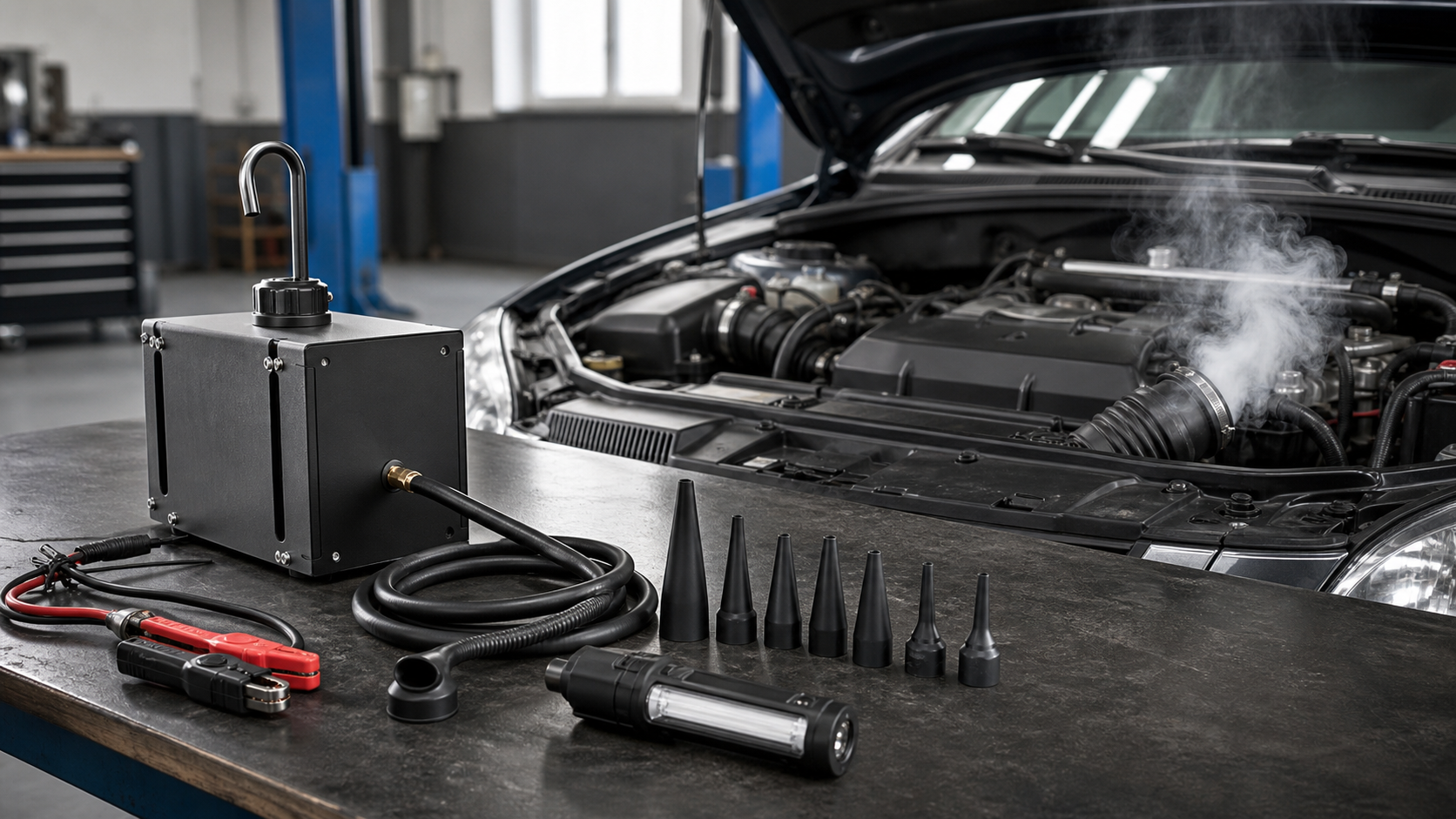
A vehicle smoke tester introduces visible vapour into a sealed or partly sealed system so escaping smoke reveals a leak. It can be useful for EVAP, intake, vacuum and some exhaust checks, but only when the machine, pressure and test connection match the system. More smoke is not automatically a better test.
Pressure control matters more than visible smoke. A useful tester gives you a controlled supply, appropriate adapters and a repeatable way to separate a vehicle leak from a poor test connection.
What an automotive smoke tester can diagnose
Common applications include:
- EVAP hoses, caps, valves and canister plumbing;
- intake ducts and vacuum lines;
- crankcase ventilation pipework;
- air leaks around accessible joints and seals;
- exhaust leaks on a cold, engine-off system when the maker permits it.
A smoke test shows where vapour escapes. It does not by itself prove that a valve operates correctly, that a sensor is accurate or that a fault code has only one cause. Combine it with a scan report, visual inspection and the correct service information.
The smoke test versus scan tool guide explains why these methods answer different questions.
The parts of a useful kit
| Feature | Why it matters | What to verify |
|---|---|---|
| Built-in pump or external-air input | Supplies flow to the system | Whether another compressor is required |
| Pressure regulation | Protects low-pressure systems | Range, gauge and relief method |
| Flow indication | Helps distinguish a gross opening from a sealed system | How the indicator should be interpreted |
| Hose and adapters | Create a reliable connection | Sizes, material compatibility and replacement availability |
| Smoke fluid guidance | Produces the intended vapour | Approved fluid type and fill quantity |
| Power lead and protection | Supports safe 12V operation | Polarity, fuse and lead condition |
A built-in pump is convenient for mobile work because it removes the need for workshop compressed air. The EVAP Smoke machine product page is one current example. Verify the live kit contents and instructions rather than assuming every photographed bung or cone is included.
Choose by system, not by plume size
EVAP systems
EVAP systems are designed around low pressure. Use the vehicle maker’s test procedure and a smoke machine intended for that job. Excess pressure can damage components or create misleading results. Isolate or command valves only as directed by the diagnostic procedure.
Intake and vacuum leaks
Seal the intake at the correct point and account for normal openings. Smoke from a disconnected hose or an unsealed throttle connection is a setup problem, not a diagnosis. Inspect brittle elbows, hose junctions, manifold interfaces and crankcase ventilation connections.
Exhaust leaks
Only test a cold, engine-off exhaust if both the vehicle procedure and smoke-machine instructions allow it. Do not run an engine indoors merely to make a smoke test more visible. HSE warns that exhaust fumes can quickly reach harmful concentrations and recommends effective ventilation and extraction for workshop engine running.
A repeatable test workflow
- Read the fault codes and save freeze-frame data before disturbing the system.
- Identify the system boundary and the correct connection point.
- Work in a well-ventilated area away from flames, sparks and hot surfaces.
- Inspect the tester, power lead, hose, adapters and approved fluid level.
- Connect with correct polarity and fit the adapter without forcing it.
- Apply only the pressure permitted for the target system.
- Check the adapter and test hose first; they are part of the sealed system.
- Use a bright inspection light and follow the pipework methodically.
- Mark or photograph the escape point before dismantling.
- Repair, repeat the same test and rescan the vehicle.
The EVAP smoke-test safety checklist is worth opening before the first connection, not after an uncertain result.
Safety boundaries that should stop the job
Petrol vapour is highly flammable and may collect at low level. HSE’s motor-vehicle-repair guidance describes serious fire and explosion risks when petrol is handled near ignition sources. Stop when you suspect an active liquid-fuel leak, strong fuel vapour, damaged electrical leads or an unsuitable work area.
Do not introduce smoke into a hot system, a fuel-filled space or an unknown circuit. Do not substitute an unapproved fluid. Keep the machine upright if its instructions require it, and allow it to cool between cycles.
An engine bay can contain moving, hot and electrically live parts. The simplest safe rule is engine off, ignition state only as required by the procedure, battery connection controlled, and no improvised sparks or heat.
How to avoid false leak results
Prove the test rig first
Block the end of the hose or use the machine’s self-check method. If the rig cannot hold a known sealed condition, fix the hose, cap or adapter before testing the vehicle.
Expect designed vents and drains
Some systems are not sealed in every state. A valve may need to be closed by a scan-tool command or isolated according to service information. Smoke at a designed opening is not a failed component.
Use time and flow together
A very small leak may need time before smoke becomes visible. A large opening may prevent smoke density from building. Flow behaviour, pressure stability and location should be considered together.
Retest after the repair
Finding one split hose does not prove it was the only leak. Repeat the same controlled setup after repair and compare the result.
Buying checklist for a UK workshop or DIY garage
- Confirm the intended systems and permitted pressure range.
- Decide whether you need a built-in pump.
- Check that the kit includes adapters for your likely connection points.
- Verify approved fluid availability and whether any starter quantity is included.
- Inspect lead length, fuse protection and hose replacement options.
- Look for clear instructions, UK support and a traceable seller.
- Save the live specification, order confirmation and returns terms.
- Ignore review badges as evidence of independent testing unless the methodology is published.
For a broader comparison of kit formats, read the smoke leak tester buyer’s guide.
Common mistakes
- Applying workshop-air pressure directly to a low-pressure EVAP system.
- Blaming the vehicle before checking the adapter seal.
- Using baby oil or another substitute without maker approval.
- Testing near petrol vapour, sparks or hot surfaces.
- Running an engine indoors without proper exhaust extraction.
- Treating smoke as proof that the first visible component is defective.
- Replacing a part without repeating the test.
- Buying a fog generator that still needs an unplanned external compressor.
FAQ
Does a vehicle smoke tester need an air compressor?
Some models include a pump; others need regulated external air. Confirm which type you are buying. A built-in pump is convenient, but pressure control and system suitability still matter.
Can I use a smoke tester on an EVAP system?
Yes, when the tester is intended for low-pressure automotive EVAP work and you follow the vehicle and tool procedures. Do not exceed the specified pressure or assume every valve is naturally closed.
Is smoke testing safe around petrol?
It requires strict controls. Stop if liquid fuel or strong vapour is present, remove ignition sources and follow HSE and manufacturer guidance. Never improvise around a potentially flammable atmosphere.
Will a smoke test clear an engine fault code?
No. It can help find a leak that caused a code. Repair the fault, repeat the test and use a scan tool to verify whether the diagnostic monitor completes successfully.
What fluid should I use?
Use only the fluid specified by the smoke-machine manufacturer and follow its fill limit. The wrong fluid can damage the unit, create unwanted residue or produce unsafe vapour.
Bottom line
A good vehicle smoke tester is a controlled diagnostic tool, not a theatrical fog machine. Choose it by target system, pressure regulation, pump arrangement, adapters and support. Prove the rig, test cold and safely, document the leak and repeat the same setup after repair.