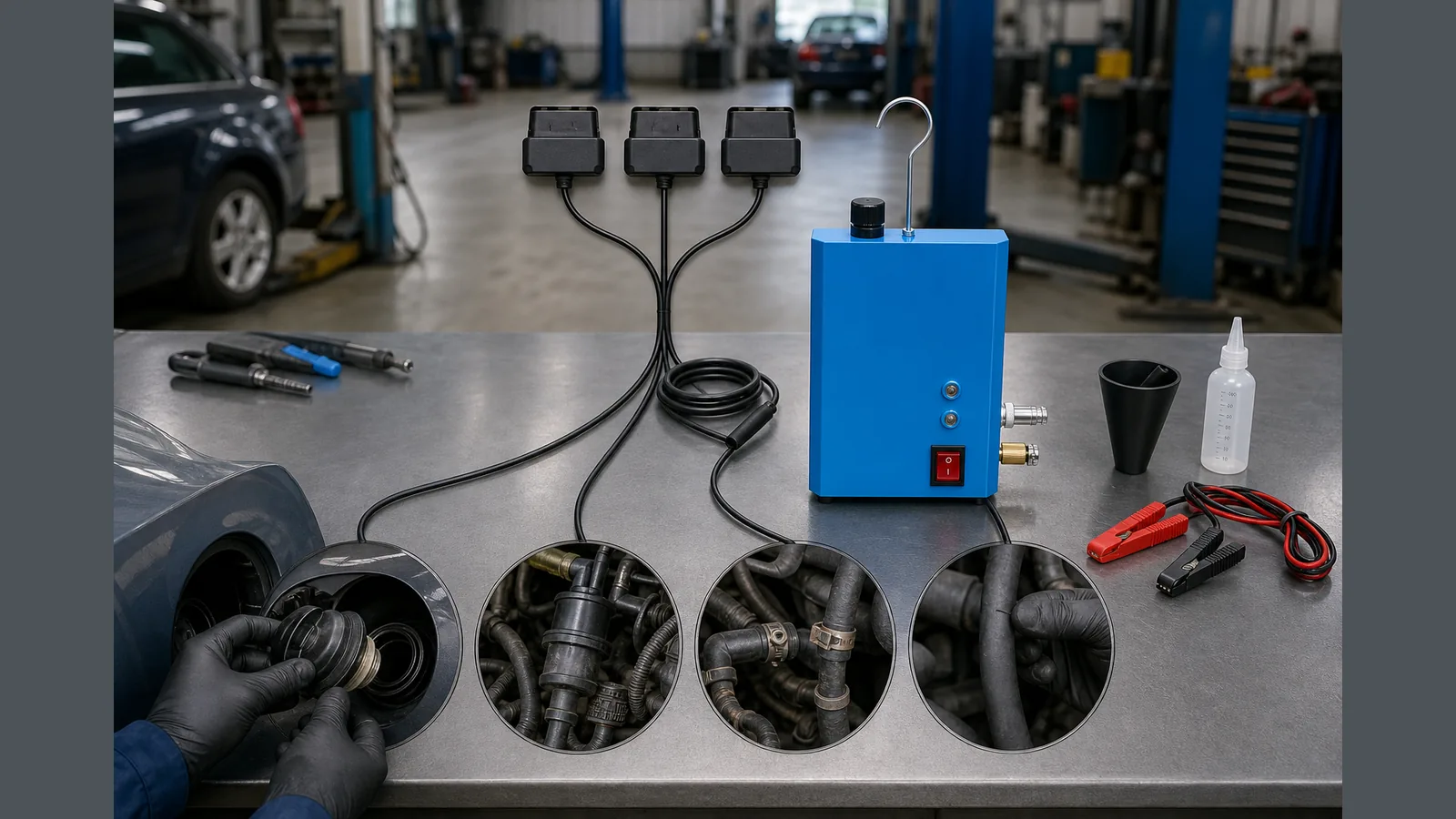
p0442 p0455 p0456 smoke test workflow
P0442, P0455 and P0456 point to an evaporative-emission (EVAP) leak category, not a named failed part. A sound p0442 p0455 p0456 smoke test workflow confirms the code on the vehicle in front of you, follows make- and model-specific service steps to prepare the system, then uses smoke only at the specified access point and pressure so you can see where vapour escapes—without guessing which hose, valve or seal is at fault.
Direct answer: codes indicate an EVAP fault category, not the failed part
These diagnostic trouble codes (DTCs) tell you the control module has detected an EVAP integrity concern. They do not, across all vehicles, map to one fixed hole size or one failed component. Manufacturer guidance treats large- and small-leak style codes as a family that can stem from different valves, connections and hoses, and calls for inspection and confirmation rather than part-swapping by code alone.
Smoke is a visual location aid after the correct vehicle-specific diagnostic setup. It does not replace service information, and seeing no smoke—or clearing a code—does not by itself prove the repair is complete.
Confirm code applicability and check the fuel cap and visible connections
Start by confirming that P0442, P0455 or P0456 is current and relevant to the vehicle you are working on. Many published EVAP flows begin with the fuel filler cap and other easily accessible sealing points before deeper testing.
- Verify the stored code(s), freeze-frame context and whether the fault is pending or confirmed.
- Inspect the fuel cap for seating, seal condition and correct fitment.
- Check visible EVAP lines, quick connects and junctions for looseness, damage or misrouting.
A workshop leak diagnosis is also not an MOT outcome: UK inspection guidance treats a malfunction indicator showing a fault, and certain induction or exhaust leak concerns, as separate inspection topics.
Follow make/model service information to close or command the system
EVAP testing depends on how the manufacturer closes, vents or commands the system. Access points, valve behaviour and which monitors must be satisfied vary by model. Use the service information for that vehicle—not a generic “any EVAP smoke” routine—to decide when the system is sealed for a leak check and how purge or vent valves should be commanded.
Nissan, for example, places P0442, P0455 and P0456 in an EVAP diagnostic flow that starts with the fuel cap and uses model-dependent test access. Apply the same principle for other marques: follow the published sequence for that platform.
Introduce smoke only at the specified point and pressure
Only introduce smoke where the service procedure specifies, and only at the pressure or method that procedure allows. Over-pressurising, using the wrong adapter or smoking an open system can mislead the diagnosis or stress components.
An automotive smoke leak detector kit, such as a SAMFD S6 automotive smoke leak detector kit (assortment 2, DC 12V vehicle power), is relevant for visual leak location once that setup is correct. Use it for EVAP, intake, vacuum and other pipe-sealing checks as the job requires—do not treat it as a confirmed method for air-conditioning refrigerant micro-leaks.
Inspect purge, vent, canister and line interfaces
When smoke appears, trace it to the source rather than stopping at the first mist. Common interface zones include:
- Purge valve and related hose connections
- Vent or canister-close valve areas
- Charcoal canister fittings
- Line junctions between tank, canister and engine bay
Large- and small-leak style codes can arise from different valves, connections and hoses; confirmation still means finding and correcting the actual leak path, then rechecking.
Use vacuum or self-test methods when smoke is inconclusive
If smoke does not reveal a clear leak, return to the manufacturer’s alternatives: vacuum decay or pressure decay where specified, commanded self-tests, and inspection of valves that may not show vapour with smoke alone. Inconclusive smoke does not mean “no leak”; it means the visual method did not finish the diagnosis for that vehicle.
Verify the repair and FAQ
After a repair, verify by the service criteria for that vehicle—retest integrity as specified, confirm related valves command correctly, and allow monitors to run as required. Clearing a stored code without a confirmed seal is not verification.
FAQ
Does each code mean a fixed leak size?
No. Treat P0442, P0455 and P0456 as EVAP fault categories within the vehicle’s diagnostic strategy, not as universal hole-size labels.
Is a smoke test enough on its own?
No. Smoke helps locate leaks after correct system preparation. Incomplete preparation, wrong access or skipping post-repair confirmation can leave the fault unresolved.
Does fixing an EVAP leak guarantee an MOT pass?
No. MOT inspection concerns and workshop diagnosis are separate. Use official inspection rules for test-day decisions; use service information for repair.
What product support applies on this site?
Products sold on this site carry a 12-month warranty. Warranty start, coverage exclusions, returns freight and claim time limits are defined in the site policy and are not expanded here.
Ready to equip a controlled smoke step in your EVAP workflow? See the current product details for the SAMFD S6 smoke leak detector kit.