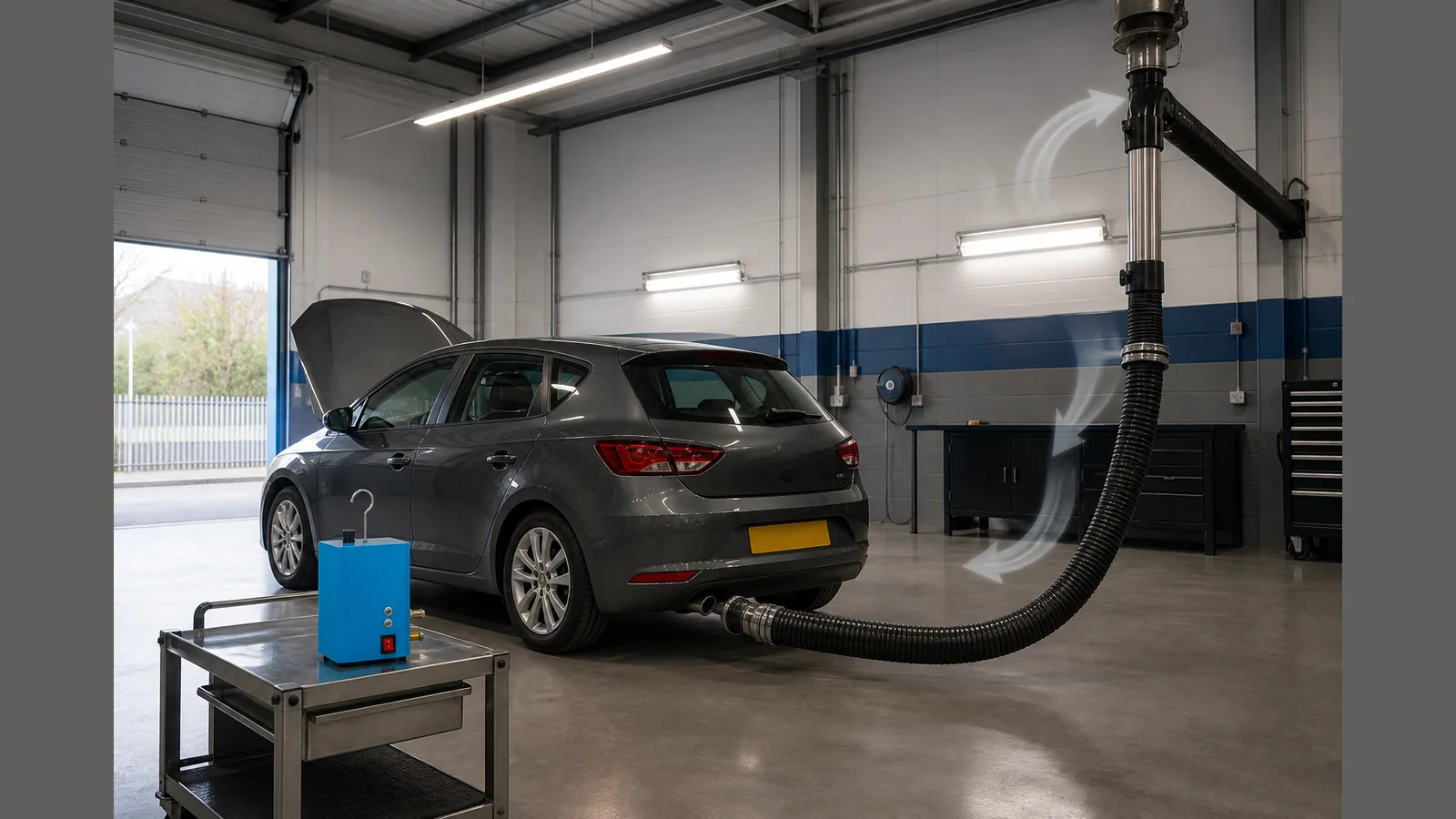
Automotive smoke testing workshop ventilation: a UK bay checklist
Plan automotive smoke testing workshop ventilation around the whole job—bay layout, bystanders, any engine running and extraction—not around the smoke tester alone. Treat diagnostic smoke work as a workshop fumes task: complete a task-specific risk assessment, follow fluid and equipment instructions, and do not assume diagnostic vapour is harmless or interchangeable with engine exhaust control.
Direct answer: plan ventilation around the whole job, not just the tester
A leak-detection smoke session can involve sealed pipework, open under-bonnet work and, in some checks, a running engine. Ventilation therefore needs to cover smoke generation, residual vapour and any exhaust that may be produced—not only the moment the tester is switched on. Open workshop doors alone are a weak primary control when engines run statically; plan extraction and airflow before the job starts.
Commercial users should complete a task-specific risk assessment and follow the fluid and equipment instructions supplied with their kit. For product context on automotive pipework smoke leak detection, see the current product details for the EVAP smoke machine.
Distinguish diagnostic smoke from engine exhaust
Diagnostic smoke from a leak tester is used to find sealing faults in automotive pipework (for example EVAP, intake, vacuum or other sealed routes). It is not an MOT opacity smoke meter and must not be treated as a substitute for exhaust emissions measurement.
Engine exhaust is a separate workplace hazard. HSE guidance on vehicle exhaust emissions expects workshops to be well ventilated and to use tailpipe exhaust extraction for static running, rather than relying on open access doors. Keep those controls distinct from the smoke tester itself.
When the engine should remain off
Many pipework smoke checks are carried out with the engine off so you can watch for escaping smoke at joints, hoses and seals without adding exhaust into the bay. Keep the engine off unless the procedure you are following clearly requires running, and never invent a “must idle” step for convenience.
If the engine must run, treat the bay as an exhaust-control job as well as a diagnostic job: connect extraction before starting, limit bystanders and stop if fumes build up.
Tailpipe extraction and general ventilation principles
HSE states that workshops should be well ventilated and should use tailpipe exhaust extraction for static running, rather than depending on open doors. HSE’s COSHH sheet on vehicle exhaust fumes in the workplace describes ventilation, tailpipe scavenging, equipment checks and maintenance records as part of exhaust control.
DVSA’s MOT nuisance guidance likewise states that emissions testing should be carried out in a well-ventilated area to prevent fume build-up. Use the same mindset for any static running that accompanies smoke diagnosis: extraction on the tailpipe, general bay ventilation maintained, and no assumption that diagnostic vapour removes the need for exhaust controls.
Bay layout, bystander control and stop conditions
Position the vehicle so hoses and extraction can reach without trapping people in the plume path. Keep uninvolved staff and customers out of the immediate bay while smoke is generated or the engine is running.
- Confirm extraction and ventilation are ready before smoke or engine start.
- Limit who stands near open bonnets, wheel arches or underbody routes where vapour may collect.
- Stop the job if visibility drops, fumes accumulate, extraction fails or anyone reports irritation—then ventilate and reassess before continuing.
Do not claim a generic exposure limit for diagnostic smoke; use your risk assessment, product instructions and HSE exhaust guidance for engine-related fumes.
Daily equipment and hose checks
HSE’s COSHH sheet highlights equipment checks and maintenance records for vehicle exhaust control. Apply the same discipline to extraction hoses, couplers and workshop fans used during smoke jobs.
- Inspect extraction hoses and connectors for damage, kinks or poor seals before static running.
- Confirm scavenging equipment operates and that maintenance records are kept as your system requires.
- Check smoke-tester hoses and adapters for obvious damage per the equipment instructions; do not improvise seals that could mislead a leak diagnosis.
FAQ and HSE links
Is diagnostic smoke the same as MOT smoke testing?
No. A leak tester finds pipework sealing faults; an opacity smoke meter measures exhaust. Do not confuse the two.
Are open doors enough ventilation?
Not as a primary control for static engine running. HSE expects good ventilation plus tailpipe extraction rather than reliance on open access doors.
What should commercial workshops do first?
Complete a task-specific risk assessment, follow fluid and equipment instructions, and align bay practice with HSE exhaust guidance and DVSA’s well-ventilated testing principle.
Further reading from UK public sources:
- HSE guidance on vehicle exhaust emissions
- HSE COSHH sheet on vehicle exhaust fumes in the workplace
- DVSA MOT Inspection Manual section on nuisance
If you need a kit intended for automotive pipework smoke leak detection, review the current product details for the EVAP smoke machine.